Categories
News

Milk Protein Advice

Milk Protein and butterfats are a huge part of the milk cheque revenue and will become even more important into the future.

The basics on Milk Protein and its production is that it requires energy to make it. Genetics in the cow are important but if you do not feed her she cannot produced adequate levels of Milk Protein.

The basics that have to be fulfilled to produce Milk proteins are:

  1. The cow must be in good health. She must not have a large fluke burden, not wheezing and coughing and able to walk without stiffness.
  2. She must be in a good body condition. This depends at what stage of her lactation she is but generally accepted between 2.75 to 3.5. Interestingly too fat a body condition score (4) impacts just as negatively on Milk protein production as too thin.
  3. She must be given adequate fuel to power milk protein production.

The general advice if these criteria are fulfilled is to feed as good a quality feed as you need to produce your target milk protein. Milk protein will depend on stage of lactation and also on grass and silage quality to a large extent.

Our DairyMax 18% and DairyExcel feedsare tailored to provide high levels of energy to your cow at a high protein level while still keeping condition on the cow. Generally feeding high protein feeds causes cows to produce more quantities of milk and can cause cows to strip condition from their back to produce this. With our DairyMax and Dairy Excel range we try to get the best of both worlds by providing a high energy feed with high levels of low protein Maize (over 25%) to keep condition on the cow. We also provide a rumen buffering agent, an active yeast and protected fat in the form of megalac to allow farmers to feed high levels if necessary in bad weather or if grass is in short supply. Even at low feeding levels these active ingredients help the cow to make the most of grass and silage by balancing her rumen and keeping it working efficiently. Ask any of our customers from 2012, 13 and 14 dairy seasons how they found it for an independent assessment. The feedback we have gotten from these products has been excellent. Proof again that we use quality ingredients to make quality results for our customers.

Paul O’Connell

Ruminant feed specialist.

Call us on 061 355186 for more details.

Categories
News

On Farms report for 1st April 2014

I’ve been able to spend some time travelling to some of our customers farms in the last few days and from talking to many of our customers and representatives we have pieced together a general on-farm report for April 1st 2014.

Dairy cow report.

In general all cows were well looked after in the dry period although not a lot of dry cow minerals were fed. Most dry cows were a little on the heavy side probably between Body Condition score 3.25 and 3.75.  What we have seen is that in herds where these cows were not fed adequately they have lost a lot of body condition score and will require serious feeding now to get them ready for the Breeding season.

If the cow is short of energy at the moment coming up to breeding season she will do her best to produce milk firstly, then she will try to keep or increase her body score and lastly she will put any left over energy into getting her reproductive cycle started.

If you are able to hold B.C.S of around 2.75 to 3 your herd will be in good shape to go to breeding. If they are below that and a lot of rib is showing and there is very little fat cover on the tailbone and pins then you need to look at the diet again and seriously consider increasing the feeding level or doing something to put more energy into the diet.

As a case study on a call last week, I was in a herd of cows that calved down at BCS 3.5. Unfortunately the calved cows were only fed 1 to 2 kilos of concentrate after calving and they have lost a full body condition score in the 6 weeks since. All cows were dosed for fluke and in general good health but the milk protein is now very low and the cows are on average 2.25 to 2.5 BCS. The farmer had been hoping to get them out on grass before now but it has not happened yet. With the body condition score so low I would have serious concerns about cow fertility and getting the herd cycling again in the near future without a serious change in diet.

Last year the herd was kept indoors for much longer due to the fodder crisis and ended up being bred indoors on a high feeding regime and conception rate was over 90% on first serving. It was an extremely busy calving period calving all these cows over a three-week period but does it not show the value of feed for conception and fertility?

He knows where he went wrong this year in not feeding adequately after calving but unfortunately will have to pay the price of a reduced milk cheque for the rest of the dairy season due to this huge loss in BCS.

Our advice is to stand back from your herd and try to put a body condition score on the herd impartially, or if you are not confident enough please feel free to ask one of our representatives to call and help you with this. it can surprise you how a herd can slip away over the course of a few weeks and you may not notice over time.

Please feel free to call us on 061 355186 for any help we can give in your animals nutrition. We believe that we are in the business of making you money through animal nutrition.

Categories
News

Fertility Booster can save you money!

Our range of Fertility booster Dairy feeds has proven to be very effective on saving our customers money. Using our practical experience and in consultation with our nutritional advisors we can offer a fertility booster mineral pack on our Dairy feeds in 2014. Those of you that experienced the positive effects of using this in previous years have proven to be the best salespeople for this great value fertility booster.

What is a fertility Booster feed?

A good quality fertility booster feed provides an opportunity to supply essential nutrients to support fertility and production of the breeding cow. Fertility booster is designed to complement grass and support the cow during the breeding season and provide these nutrients at an appropriate feeding rate.

Trace elements play a critical role in supporting production and fertility in the cow. Fertility booster, boost trace element levels in feed and ensures adequate intake’s at this critical time.

Magnesium – is involved in over 300 biochemical process in the cow many essential to metabolic and hormone function. Many farmers only feed magnesium to prevent tetany. It is not unusual to see low blood magnesium in cows during the breeding season. Use of compound fertiliser increases herbage level of potassium. This reduces magnesium level in grass and the cow ability to absorb it.

Copper

Affects conception rates, bulling behaviour

Iodine

Plays a central role in regulating many hormones

Zinc

Health, mastitis, cell count

Cobalt

Important role in energy metabolism

Manganese

Silent heats

Selenium

Conception, health, mastitis


Iodex– protected source of Iodine. Iodine is an important trace element at this time. It controls metabolism and hormone function. Herbage levels are typically low and it needs to be fed daily as it is not stored.

The benefits of ensuring good fertility are many,

1.Compact calving pattern

2. Less serving costs

3. Can help high yielding cows fertility problems

4. Saves carrying a blank cow around for the year. This is estimated at costing you over €1000 per cow annually.


Call us on 061 355186 for prices on our range of Dairy fertility feeds, available in both ration and pellet form at a modest cost. Please allow at least 2 working days notice when ordering  as we make these feeds specifically on demand.


Categories
News

Spring Grazing effects on Grass production

The weather looks to be improving after the long spell of wet and cold weather. For the near future at least the outlook is for good drier weather with a decent amount of wind which should help drying conditions.

There is a lot of pressure on farmers now to get fields grazed to allow for slurry application and general fertiliser spreading. This pressure is going to result in some difficult decisions to be made regarding when to go into certain fields and with what stock.

Teagasc maintain and they are probably right that one of the main keys to profitability on farm is “How much grass you can grow on your farm”. The top farms in the country can grow 14 tons per hectare while the average in the country is only 8 tons. How do we grow more grass, long-term economically.

Most of us are after spending a lot of money on re-seeding ground in the last few years. The key to keeping these fields fertile and productive is to try to maintain the soil structure as best we can. Travelling wet fields with heavy machinery is a well-known cause of soil compaction which destroys soil structure and takes years to correct. Another less appreciated but equally harmful cause of serious soil structure damage is caused by Animals travelling on soil that is not dry enough to support them. After the recent long spell of wet weather the population of beneficial micro organisms is very low due to land being waterlogged. The earthworm population is indicative of this.

Take 5 minutes as an experiment on your own farm soil structure. Pick a couple of areas at random across your farm and dig a 12 inch square hole about 12 inches deep. Count the number of Earthworms that you find? If you had excellent soil fertility you could expect to find up to 20 Earthworms. From testing this across our customers we are finding 2 to 3 at best. This means that soil structure will be under pressure from the start this spring as there are not enough worms to dig through the soil to make air ways to allow it to breathe and drain properly.

Difficult decisions are going to have to be made. Obviously it is best to get out early where possible to graze the farm. It will be a trade-off between getting out early to graze and damage soil structure for the future, or grazing just the driest fields with light stock and hold some indoors.

One word of caution about grazing dairy cows. Changing the diet of a freshly calved cow drastically from a silage based diet to a grass based diet is a serious ask if everything is going in her favour. It will take her a few weeks of consistent feeding to adjust properly to a new diet. If conditions are not ideal and she is not getting adequate nutrition from lack of grass or she is not able to process the grass then you can expect problems in terms of milk yield, milk solids, reproductive cycling and body condition. Remember the egg you are hoping to serve is being made 6 to 8 weeks beforehand and can be lost anytime in between. Most of my customers who kept dairy cows indoors last spring due to the woeful spring commented that it was the best fertility they ever had due to not abusing the cows by putting them out for a few days and then bringing them in etc.

So some difficult business decisions to be made over the next few weeks. You don’t have to do it on your own, if you need any help on this or other matters please feel free to contact us on 061 355186 as we are dealing with helping farmers across the Mid-West everyday.


Categories
News

Dutch Indoor Dairy Production. How do they do it??

I recently had the opportunity to visit a Dutch dairy farm. I found it quite eye opening to see how the Dutch method of Dairying compares with the Irish method.

The first thing that strikes anyone visiting rural Holland is the lack of cows in the fields. The land there is very well drained and the control of water is vital to Dutch agriculture. They need to drain the land and also in summer use water for irrigation.
The fields are very well kept, no visible weed population, no poaching, no unproductive barren areas and every square inch of land is used.
About 50% of the land is taken up with maize silage, 40% with grass silage and some red clover silage fields.
Land is very expensive in the Netherlands costing about €90,000 per hectare in the area we were in, consequently it is fascinating to see how much the Dutch really appreciate it.
The dairy farm we visited appeared to be a typical Dutch farm. The farm yard is situated right beside the road, and consists of a large concrete yard with the sheds and silage pits.
All the Dutch farms are kept very clean, large concrete yards, no rubbish, no old machinery lying around, no evidence of what we would consider typical farm conditions here in Ireland!
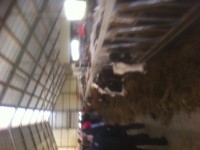
The farm we visited was a 160 cow farm running on 62 hectares. The main cow shed was built new in 2010 and was bright, clean and very well ventilated. The herd of cows were very clean, no dirty marks on them and were one of the most content looking herds I have ever seen.

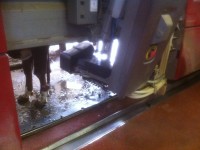
The first thing we asked the farmer was how long did he spend milking his 160 cows and his farm work in general. The answer was ” maybe an hour a day sometimes an hour more but mostly an hour a day”. He achieves this by employing 4 robot milking machines to carry out the milking for him. His shed is separated into 4 sections each served by a LELY robot milking machine. The cows enter the robot when they are due to be milked and the robot dispenses their compound feed and milks the cows 3 times a day. Each cow has an individual band that lets the robot know who she is, if she is due to be milked and records how much milk she produced and a rough idea of the cell count of each cows milk is recorded. Interestingly his herd is being built up to 200 cows and on average are only on their third lactation so these young cows are working well on the robots.
It is the farmers job every day to walk through the cows once in the morning and once in the evening and check the robots records. If a cow has missed a milking or is significantly down on production the robot will alert the farmer.
His most time consuming job each day is to fill the diet wagon and feed them each day. He also has a LELY feed robot that pushes in the feed to the cows every couple of hours. The feeding space where the silage sits is tiled to enable it to be cleaned properly.

The next question was how much did all this cost? The new shed, milk storage system, feeding system, 2 robot scrapers, feed robot and 4 milking robots cost nearly 1 million euro for the 160 cow herd.
The robot milking machines cost around €100,000 each. He had recently sold 2 of his older 6  year old robots for €60,000 each when he built this new shed.
Its a huge outlay of money but it allows him to milk very consistently with ease. The cows are used to the system and are very easy to manage as they are on a consistent diet at all times. They do not have the burden that we ask of our cows of changing diet from silage to fresh grass overnight and have the challenges of being outside in the cold and wet day and inside by night and often in tough grazing conditions.
This farmer has 62 hectares of land to grow his fodder for the year so he grows a crop of 40 hectares of maize silage and 6 crops of grass silage from 22 hectares.
He owns only 2 tractors, and a loading shovel. All other work is done by contractor and that is typical of the Dutch system.
The economics of the indoor diet are fully dependent on what his input costs are. He can buy Sugar beet at 25% moisture at a relatively cheap cost from Germany and Poland which he puts into a pit. He has to pay to get rid of his Manure as he cannot spread it all on his land so 4 loads a week go to France or Germany to be spread in the vineyards or on arable land.
When we were talking to this farmer he is quite envious of the Irish dairy system in a lot of ways. Our land prices are far cheaper and we have a great ability to grow grass all year round. His biggest fear is the milk price relative to the input prices. He made a very good point that Milk price is not really that important, it is the margin between what you sell and what it costs you to produce that is important. It is no good having record high milk prices if input costs are also very high.
His plan to offset lower milk prices is to put aside €1000 per cow for the inevitable years where his margin is under pressure.
All in all it was fascinating to see this system in operation first hand. Surely there is some parts of this system that we could incorporate into our Irish systems to make our jobs easier and more productive.

Categories
News

World Soya prices hit a 2 month high

The following Financial Times article highlights the challenges that we face on a day to day basis to get the best value for our customers. With Soya prices continuing to rise and bringing the price of feed protein up with it, we at O’Connell Milling are working hard sourcing quality raw materials from across the globe in order to maintain the high quality of our feeds at a price that offers value to our customers.
Call us today for your Animal Nutrition needs. From our range of tried and tested Dairy and Beef feed to one off special formulations, we have something to suit everyone.

Financial Times Article Explaining Argentine Farmers Hoarding Soyabeans
Peso plunge forces Argentine soya hoarding

By Emiko Terazono in London, Gregory Meyer in New York and Benedict Mander in Buenos Aires,

“Pesos are no use – the worst thing you can do is hold pesos.”

Alfredo Rodes, executive president of farm association Carbap in Buenos Aires province, speaks for many of Argentina’s soya farmers who have turned their backs on the local currency.

Faced with a sharp fall in the peso as emerging markets are battered amid concerns over the fallout of central banks’ unwinding of monetary stimulus the country’s soyabean growers have packed their dollar-denominated crop into “silo bags” rather than sell it for cash, determined to hold on to it as long as possible.

A new harvest is now set to start in April. With Argentina accounting for about a tenth of the world’s soyabean exports and almost half the soyameal trade, farmers’ decisions on whether to keep hoarding will ripple through global futures markets.

The consensus: widespread soyabean storage will continue.

Farmers “see their crop as a protection of value against the potential devaluation. So we’re monitoring much more that impact,” Juan Luciano, chief operating officer at Archer Daniels Midland, the agricultural trading house and processor, told analysts last week.

The decline in sales volumes by farmers initially hit the market at the start of last year, as concerns about peso devaluation and rising inflation deepened. Soyameal prices remained firm on the “selling strike” while the lack of soyabeans affected global companies such as ADM and rivals Bunge, Cargill and Glencore.

The latest currency turmoil has sent the price of soyabeans up more than 20 per cent in peso terms since the start of the year. By contrast, Chicago soyabean futures – traded in dollars – are up 1.6 per cent at $13.33 per bushel.

But with further devaluation fears and Argentina’s inflation rate almost 30 per cent, analysts do not expect farmers to liquidate their bean piles.

“Unless a mechanism becomes available for producers to convert soybeans into assets that can retain their value in the current inflationary environment, limited producer selling is likely to continue,” the US Department of Agriculture says.

Argentine growers have only sold 6 per cent of their soyabean crop to crushing plants and exporters, according to the latest figures from Macquarie. This compares with 11 per cent at the same time last year, and 25 per cent for the year before that.

Soyabean inventories left over from last year’s crop in Argentina will total a record 9m tonnes before this year’s harvest, almost doubling annually, the USDA estimates.

“This is usually the time of the year where the crop has mostly been sold and there is almost no stock left,” says Paula Savanti, analyst at Rabobank in Buenos Aires.

Unlike counterparts in other countries who are forced to sell harvests quickly to big agribusinesses, many Argentine farmers’ access to the low-cost, high-tech silo bags gives them freedom to store and sell their soya when they want.

Alejandro Quentin, chief executive of Pampa Capital Management, an agribusiness investment group, says Argentina’s farmers “are very independent and do not need to [use] expensive infrastructure to store crops” thanks to the bags.

While processors and the big soyameal buyers will be watching and waiting for the soya to flow, analysts believe that unless the currency and inflation rates change in Argentina, farmers will behave similarly to last year.

Chris Gadd at Macquarie in London believes that while farmers will come to the market once the harvest starts in April, to raise cash to pay for seeds and fertilisers, the flow will slow during June and August, just before the US soyabean harvest.

“Under this scenario, we would expect the world’s meal consumers to have as large a challenge in securing meal as they did in the June-
August period last season,” says Mr Gadd, adding that “it will be a hand-to-mouth situation”.

Stocks of soyabeans in the US – which, with Brazil and Argentina, is one of the top exporters – will shrink to the equivalent of 4.5 per cent of annual consumption by late August, just as low as in 2013, USDA forecast Monday.

The tense relationship between Argentina’s farmers and the government may worsen over the next few months if, as expected, Buenos Aires pressures farmers to sell their crops to help generate revenues in foreign currencies.

Hector Huergo, an agricultural engineer who formerly headed the National Institute for Agricultural Technology, ridicules the government’s attacks on farmers for hoarding their stocks. “If I have a fridge full of beer, I’m not hoarding if I don’t drink it all at once – I drink it as and when I’m thirsty,” he says.
Categories
News

Latest Storm Update

The latest information is that todays forecasted storm will not be as severe as Wednesdays storm Darwin. However there is a lot of rain forecast for today and tonight along with very cold temperatures leading to sleet, hail and snow in places.

Please Make sure your buildings and animals are secure and stay indoors in a safe place during any high winds.

Our mills have been hammered hard over the last few weeks with these succession of storms but while we have had to make some repairs to roofs and clearing trees from roads we have escaped far better than some of our neighbours. To all the great volunteers who have taken big risks to clear roads and passages we would like to say a huge thank you.

Our staff have been on the road since very early this morning to ensure all scheduled deliveries are completed safely. This afternoons deliveries have been scaled back today for safety sake as tipping loads in high winds is very dangerous.

If you find you are low on feed please let us know as early as possible via one of the mills phone lines 061 355186, 069 72900 or 068 40208 and we will get to you as soon as it is safe to do so.  Please be aware that phone lines are not always working during the last few days but if you call one of the other mills we will route the information to head office.

Categories
News

Summary of the Crecora Dairy Seminar 5th Feb 2014

My thanks to Des Cronin from Inform Nutrition and all the delegates who braved the inclement weather to attend last night.

We had a very informative talk on cow nutrition, cow health and how to boost her productivity economically.

Des has been working for Inform Nutrition in Cork for 18 years and has been in the feed trade all his working life. He comes from the West of Ireland and has been living in Effin Co Limerick for the last 15 years. He has plenty of experience with on farm health and productivity. As part of his job he provides technical help to O’Connell Milling in formulating rations and assisting with farmers who have health problems. He has been sent to  20 different countries in the last 10 years to give his practical Irish knowledge.

The first point made was that what you put into a cow, you get out. If you don’t fill her nutrition needs she will not give you the return in the form of cash.

We started the talk on Pre- calving nutrition.

Des made the point that this is a vital stage in a cows life and correct nutrition here will allow her to produce more milk through her lactation, ensure a healthy calf and ensure the minimum of problems.

He highlighted the importance of Body condition at calving (BCS 2.75 to 3.25 is ideal) . He also highlighted the importance of keeping fresh feed in front of a cow before calving as her ability to eat reduces by 30% due to the size of her calf restricting the size of her rumen. If she does not eat enough before calving she will be weak at calving and problems will occur. The level of Potash (K) in silage has doubled over the last 10 years due to slurry being spread on silage ground very late. The Potash in this slurry is not broken down fully by the time of cutting and this leads to it coming in with the silage. This excess Potash has a huge effect on the cows metabolism and quite often causes Milk Fever. This high Potash silage would be safer fed to milking cows. Ideally we recommend putting aside bales from paddocks that did not get any slurry and using them for the dry cows if at all possible.

At Calving time Des had a few recommendations. After calving offer the cow a bucket of water pretty much straight away. The cow will not leave the calf to drink from a drinking bowl just after calving and she needs the water. If you were after running a marathon you would be looking for water and the cow is after a similar experience. She should drink 15 to 20 or more litres of water immediately after calving. Watch out for the cow that does not drink! She is telling you that there may be something else wrong with her.  Similarly after calving make sure she has fresh fodder in front of her and offer her a bit of concentrate. The first hour after calving is the best time to do this as after an hour the adrenalin in the cow wears off and she starts to feel sore, sick and will not eat enough. Des feels that the cow should have a bit of time in the calving pen after calving as if she goes straight into a shed with other cows she will often not compete for food and will lose excess body weight. This can affect her milk yield over her whole lactation.

Post Calving ideally we should be introducing small amounts of concentrate to get her system used to it before going straight onto the full dairy milking diet. Begin small and work your way up over 3 to 4 weeks if at all possible. He showed some research that was done that showed the benefit of feeding modest amounts of concentrate post calving to minimise weight loss and to get the cow reproductive cycle going faster and healthier. Remember at the time of serving that her egg was formed three weeks earlier.

Des also made the point on soil fertility. We need to get a good handle on our soil fertility and we are only know starting to spread lime in earnest down south. In the North of Ireland for the last 15 years he said you could not travel a road without meeting a lime spreading outfit.

If you are making silages of DMD66 regularly you will need to reseed those fields on average every 3 to 4 years to keep the yield up. If you can make silages of 702 or above that falls to every 7 years! this is due to in 66 DMD silages we are asking the grass to head out to seed and the process of seeding out takes a lot out of the plant. If we cut 20 May for 70 DMD silages we are not asking the plant to do this so the grass will last longer.

On grazing. As an experiment he asked any farmer that was feeding 12 hour blocks to cows to try feeding 20% more grass once a week to see if the cows will graze it down. In his experience Irish farmers drastically over-estimate the actual grass intake on a daily basis which results in cows going hungry and not performing to their peak. Milk solids are affected by this. If a guy says sure if I gave them more grass they would have the whole place eaten in a few weeks then he is not feeding enough. If the cow is hungry she will not perform. If you go out to a 12 hour grazing block at 1 o clock and the place is bare then those cows are hungry until milking time. This can lead to all kinds of upsets, acidosis and poor milk solid performance.

2nd rotation grass problems. Grazing into the 2nd rotation is the biggest change in diet that a cow will face all year. She has gone from cleaning out a paddock with fibrous grass that has been growing since Autumn to eating lush, leafy rapidly fermentable grass that has only been growing for a few weeks. It will take her 3 to 4 weeks to acclimatize to this new diet. This time of the year is when cows become very loose, go off their food, pick up stiffness in their joints and after a few weeks may show signs of lameness. These are generally caused by a mild or in some cases a not so mild case of Rumen Acidosis. Acidosis occurs when the cow is given rapidly fermentable grass in her diet and the acid PH level in her rumen drops giving her what we consider bad heartburn. the grass passes through her system too fast and she will not chew the cud with it. When she chews the cud she produces up to 1.5 kilos of Bicarbonate per day in her saliva which buffers her Rumen. If she is not chewing the cud, she cannot get this Bicarbonate into her rumen so she develops acidosis.  She will go off her food as a result and Milk solid performance can take a nose dive.

To try to help this situation we recommend that you don’t put cows onto this grass hungry. Feed them some silage or straw before grazing if possible and consider using a buffering agent such as RumBuf in your feed to help her along. Try to introduce them to this grass a gradually as possible. Once her Rumen is acclimatised she will be able to handle this grass and make best use of it.

In bad cases of Acidosis treat with Antacid or buffering agent as soon as possible.

What affects Intake indoors. Milk yield, fodder quality, days in lactation and feeding space are some of the big variables. In the rest of the world a cow indoors generally has 10 metres by 10 metres space allocated to her, has plenty of room to eat and is presented with 74 to 80 DMD silage.

Des made the point that we need to get into the habit of making better silage of at least 70 DMD. This will allow us to feed this silage to cows indoors calving earlier and maximise our days in lactation.

In a post Quota system we already can expand our Milk yield by 15 % by just keeping doing what we are doing. With a little more feeding and some small changes in practices we could get 30% more milk and solids without ever going up in numbers. That is worth thinking about.

The take home messages were,

Watch cows at calving for poor eating.

Give the cow a bucket of water and a small bit of concentrate as soon as she has calved and monitor if she drinks and eats.

Grass is a great feed but make sure the cows are getting enough of it. If they are going hungry they need supplementation to maximise milk and milk solid yield.

What you put in, you get out. If you feed the cow she will respond in the long-term with better health, better fertility, more milk yield and more milk solids.

16kg Dry matter intake a day is the minimum we should be aiming for.

Feed Dry cows silage with low potash. Lighter coloured bales or parts of the pit. Dark coloured silage is generally are high in Potash.


Categories
News

Summary of Listowel Dairy Seminar

Following on from the Dairy Seminar hosted by O’Connell mills and held in Listowel last night here is a brief summary on the topics discussed.

Morgan Sheehy from Devenish Nutrition spoke about his 3 legged stool concept for Irish farmers.
The three legs of the stool are, Farm Management, Animal Health and Animal Nutrition.
If there is a problem with any one of these legs then the stool can not stand.
Often times when we visit a farm with a problem it is one of these areas that is holding back the cow performance and with some small changes it can be fixed easily.

Moulds and mycotoxins are becoming a huge problem on farms. Moulds are the single biggest contributors to food loss and wastage in the world.
Dry silage that was made last summer has proven to be very susceptible to moulds and often times we can’t actually see them but if the silage is heating its a safe bet there are moulds present. Best advice is don’t feed it to the animals, and also stay as far away from it as you can yourself as if you breathe in the spores from the moulds it will depress your immune system and can cause farmers lung among other serious health problems.

Silage swards with large numbers of docks are similarly very vulnerable for moulds as the dock plant releases moulds when it seeds to kill off its own leaves.

Dry cow nutrition.
Getting the dry cow nutrition correct is vital to the long-term milking potential of the cow along with preventing expensive calving problems such as Displaced abomasums, milk fever, retained afterbirth and womb infections.

The cow in the run up to calving needs to be at body score 3 and have energy available for the calving and transitional process. In the last 3 weeks of her pregnancy her intake is reduced sharply due to her calf pushing on the rumen. It is vital that she is provided with enough energy for the calving process without losing more body score so we must feed dry cow concentrate to make up for the energy deficit.

Milk fever and sub clinical milk fever have a huge effect on the cows performance and her ability to get back to production quickly. Milk fever can be caused by the level of Potassium in the fodders that we are making in modern farming. The Potash levels on silages have been rising steadily over the last 20 years leading to an imbalance in the cows ability to combat Milk Fever, mainly caused by large amounts of slurry in the silage ground.

Best practice would be to cut a field at some stage over the summer that did not get any slurry and keep that aside for the dry cows in their final 8 weeks of pregnancy. If you are feeding pit silage often you will see a band of dark and light coloured silage in the pit. Generally the lighter coloured silage is the silage lower in Potash so this is the silage you want to feed to your dry cows. Morgan told us of a few incidences on farms of Milk fever that was cured by using this simple approach.

Similarly chopping fodder too fine can lead to acidosis due to the fodder being absorbed too quickly.

Feeding the calf

Calf feeding takes a pile of time on farm. No question about it. The aim has to be to get healthy calves up and thriving as fast as possible. It takes a lot more time and effort to feed a sick calf than a healthy one.

Colostrum is vital to the health of the calf as it is born with no antibodies to fight disease. The rules about colostrum is get 10% of the calves bodyweight of the best colostrum into the calf as soon as possible, as fast as possible.  For a 30 kg calf this would be 3 litres. The effectiveness of colostrum after 6 hours is only 66%, after 12 hours it is 50% and it reduces even faster after that. Speed, quality and volume are the 3 keys to remember.

The recommendation is to try to stimulate rumen development in the calf as early as possible. We want the walls of the rumen to develop the honeycomb structure that is essential to increase the surface area of the rumen to handle large amounts of roughage. On a Milk only diet generally calves rumens do not develop well. On a hay and milk diet they still do not develop particularly well staying quite smooth even after 8 weeks.  The best diet after extensive trials worldwide is a straw and concentrate diet. You need good quality clean straw presented in small amounts and kept fresh. Also the concentrate should be just a handful to start and kept fresh to encourage them to eat it. Little and often are the important factors here. Generally accepted that they need 12 weeks to wean effectively.

We had a good discussion on grazing heights and cows Dry Matter Intake ability. Morgan made the point that asking a cow to try to pull grass at golf ball grazing height with her tongue into her mouth and get a decent dry matter intake was just not feasible. She will not be able to fulfil her intake needs on this and will suffer with milk solids and yields as a result.

The maths is simple, she takes 60 bites with her tongue per minute, for 10 hours grazing time is 36000 bites per day. Even at 7cm grazing height that is only 0.14 grammes per bite that does not stack up! While we all agree that the best grass quality is achieved by leaving as little cover on the ground as possible after grazing this is seriously holding back the performance of the cows in terms of Milk Solids and yield as she is not being given enough fuel to make the Milk Solids.

Morgan also gave an example on how a simple graph can do wonder for farm management.

If you plot the Milk solids divided by the number of cows in the tank on the x axis and the dates on the y axis you can plot a graph on how your herd performance is going on an annual basis. The graph should not have any big jumps or steps in it, it should be a relatively smooth graph. If there is big steps it may indicate problems such as that every time the cows enter a certain field in the rotation the Milk Solids drop. Morgan made the point in 9 times out of ten cases where he is called to solve a problem on farm with milk solids this graph can explain a lot.

We have used this on farms to great effect.

We had a post quota discussion and Morgan made the point that on his travels worldwide the general feeling is that world milk price is set to stay high for the short-term. In his experience in other countries the successful dairy farmer is one that can keep some of the profit in reserve for the year when the price may not be as good. He also made the point that even if milk price falls, if global input costs come down you may be able to still make a very decent profit.

Upon talking to the attendees afterwards the feeling was that it was a very informative session with plenty of information to bring home to help run the farm business a little more effectively going into the future. Morgan had plenty of small tips from his experience on farms that could make a big difference to farm profit.

Information is the key to making good farming decisions in the future.

The take home messages:

Benchmark from your own farm and situation. Not off your neighbour down the road.

Get as much output from what you have before expanding herd size.

If one of the three legs of the stool are wrong, the stool can not stand up.

Categories
News

Summary of Castlemahon Dairy Seminar

Thanks to all that attended the dairy seminar in Newcastlewest last night. It was an informative discussion on Dairy nutrition, maximising fodder and feed and the future of dairy in 2015.

The main take home points that were made are that Dry matter Intake  (DMI) drives production in the Dairy Cow. If all we do as dairy farmers is to maximise the cows intake we will make 80% of our target yields.

DMI drives milk solids and is influenced by the quality of fodder, quality of feed, the Dry matter digestibility (DMD), acid potential, days in lactation and energy level of the feed.

The cow is essentially a walking stomach with a huge rumen of 50 gallons. If we manage the rumen correctly it will drive production in the most efficient, cost effective way possible.

Good silage (70 and above) is the second cheapest feed after grazed grass.

Bad silage (low 60’s) is the most expensive!

We should be aiming for 74 DMD silage with a cutting date around Mid May. Every week after that DMD drops significantly. For every 5 points drop in DMD you will need 1 kilo of concentrate to supplement it. Aim to graze your silage ground first to allow a decent cover on it by May.

Moulds and Mycotoxins are also becoming a big problem on farms. Ten years ago moulds would not cause any cow fatalities but possibly through the advent of whole crops and Maize silage the types of moulds in the county have changed and become more poisonous. Also when we are cutting our silage if there is a large Dock weed population in the silage ground, chances are the dock weed has gone to seed. When the dock goes to seed, it relies on a mould to kill off the parent plant leaves. If we put a large amount of this into our silage we are including a lot of these moulds and if they get any air supply they will flourish in the pit or bale.

Acidosis has been and continues to be a major production problem on farms. When the Ph level in the rumen drops below 5 the cow will have reduced intake, milk solids will drop, and potential problems with hooves can occur 3 to 4 weeks after incidence due to drops in the hoof making their way down.

We need to manage the cows intake to prevent this while still maximising her yield potential. Spring grass is one of the biggest problems with acidosis.

Feeding strategies.

Dry cows ideally need mineral supplementation at least 3 weeks before calving. The recommendation is to feed a 2 to 3 kilos of a pre calver ration such as our Dry Cow Calf Shield in this period. The benefits are to provide her mineral needs such as magnesium coming up to and immediately after calving  while also not adding calcium till she is calved. We also need to provide her with a source of energy for calving as she will lose 30% of her intake potential due to the calf size shrinking her stomach.  It will also get her in a better position to maximise her intake post calving by acclimatising her rumen to compound feed which will result in less incidence of post calving acidosis. Ideally we do not want her eating the dairy compound till after pregnancy when she needs to mobilise a lot of calcium.

In the 3 to 4 weeks after calving we should be acclimatising the cow to grass if possible for 4 to 5 hours a day and getting her rumen functioning by introducing the dairy compound diet slowly over these 4 critical weeks. We need the cow to have plenty of energy available to supply milk and also just as importantly to get her to cycle ready for breeding. Letting the cow straight onto grass day and night after being used to a diet of straw and silage require a huge change in the rumen function that takes a 3 to 4 weeks to change over. Going straight onto grass often leads to 2 to 3 weeks of serious weight loss with subsequent breeding and production problems.

Spring Grazing. This can be a tricky time of the year to maximise DMI. After the first grazing rotation the spring grass is very lush high in protein and highly fermentable. This can often result in the cows rumen not being able to handle this material fast enough and acidosis will occur with all the problems associated with it. To prevent this happening we should be looking at adding more fibre into the diet using a grazing nut such as our Dairy Maize to Graze or adding more fibre in the form of straw or where this is not sufficient we should be using 2 to 3 kilos of our compound feed as soya hulls or palm kernel. This will prevent the drop in milk solids and keep the DMI up by ensuring “gut fill”. If all we do is ensure the DMI is optimised we will be meeting 80% of the cows needs.

Summer period is a much easier time to manage as grass is not so highly fermentable not as high in protein and grazing conditions are generally manageable. Again it is vital to keep the dry matter intake up by ensuring the cow gets as much good quality grass as we can give her.

Closing off the grazing platform will depend on how much cover you want to leave on the fields, grazing conditions and silage availability. If it looks like you are short of silage for the winter at this stage consider supplementing with compound feed to keep dry matter intake up, keep milk solids up and to maintain body condition score. 1 kilo of feed will replace 5 kilos of good silage.

Other points that were made were the huge difference between the top 10% of farmers and the bottom 10 %.  The top 10% are making profit of around 2400 euro per hectare. The bottom 10% are only making 200 to 400 euro per hectare.

The factors influencing this are income generated from the number of milk solids in the year. We need to maximise our milk solids now and into the future. We should be breeding for milk solids and yield.

The feeling on expansion post quotas is that we can do a lot to improve yields and milk solids without increasing the stocking rate beyond what the grazing platform can comfortably handle.  If we manage DMI, breed for yield, extend days in lactation from 240 days to 300 and manage the cows rumen we can generate a lot more income for far less risk.

The general consensus was that what we discussed was pretty much common sense, don’t treat the cow like a robot, manage her intake, don’t go to extremes with her feeding and she will reward you with high milk solids, high yields, good health, easy calving and easy breeding.

In short a good common sense discussion looking towards the future which we should all be positive about. If we are willing to maximise our farms potential there will be a great income to be achieved. Thanks for your attention.

Paul O’Connell

Crecora Mills

Privacy Overview

This website uses cookies so that we can provide you with the best user experience possible. Cookie information is stored in your browser and performs functions such as recognising you when you return to our website and helping our team to understand which sections of the website you find most interesting and useful.